 Ihyaaud Deen An Effort to Revive Deen in Totality
The Destroyer of Idols
In the time of Rasulullah (sallallahu ‘alaihi wasallam), the disbelievers of Makkah Mukarramah would worship idols and statues. Allah Ta‘ala sent Rasulullah (sallallahu ‘alaihi wasallam) to guide the people towards worshipping Allah Ta‘ala alone, and to stop them from worshipping idols.
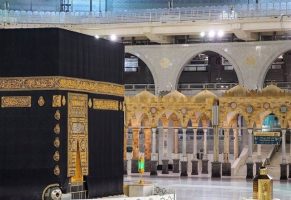
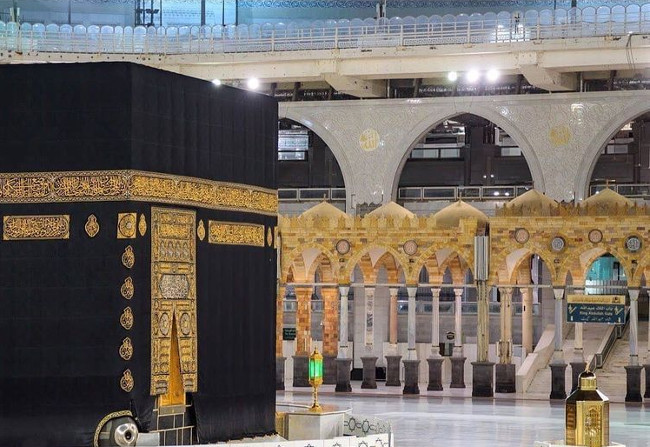
On the occasion of the Conquest of Makkah Mukarramah, Allah Ta‘ala blessed Rasulullah (sallallahu ‘alaihi wasallam) with victory against the disbelievers. When he entered Makkah Mukarramah, he came to the Ka’bah Shareef and saw that the disbelievers had placed 360 idols and statues around the Ka’bah Shareef. As Rasulullah (sallallahu ‘alaihi wasallam) passed by each statue, he pointed towards it and hit it down while reciting the following verse of the Qur’aan Majeed:
جَآءَ الۡحَقُّ وَ زَهَقَ الۡبَاطِلُ
The truth has come, and falsehood has perished. (Surah Banu Israa’eel v. 81)
Thereafter, Rasulullah (sallallahu ‘alaihi wasallam) wished to perform salaah inside the Ka’bah Shareef. However, when the door of the Ka’bah Shareef was unlocked and opened for Rasulullah (sallallahu ‘alaihi wasallam), he saw that the disbelievers had placed idols and statues inside the Ka’bah Shareef as well.
Rasulullah (sallallahu ‘alaihi wasallam) commanded that all the idols and statues should be taken out from the Ka’bah Shareef, and the inside of the Ka’bah Shareef should be washed with Zam-Zam water. It was only when the idols were taken out and the Ka’bah Shareef was cleansed with the Zam-Zam water that Rasulullah (sallallahu ‘alaihi wasallam) entered and performed salaah.
From this, we see that Rasulullah (sallallahu ‘alaihi wasallam) hated idols, statues and all forms of pictures of people and animate objects. It is for this reason that Rasulullah (sallallahu ‘alaihi wasallam) had also sent certain Sahaabah (radhiyallahu ‘anhum) to different places to destroy the idols which people were worshipping.
Approximately 400 years after Rasulullah (sallallahu ‘alaihi wasallam), there was a pious king who lived in India. He was known as Sultaan Mahmood Ghaznawi (rahimahullah). He spread Islam in India, and how Rasulullah (sallallahu ‘alaihi wasallam) had destroyed idols, he followed the way of Rasulullah (sallallahu ‘alaihi wasallam) and destroyed many idols in India which the people were worshipping.
Among the main idols of the people in India was a very big idol called Sawmnaat. Thousands of people would worship this idol. When Sultaan Mahmood (rahimahullah) heard about this idol and the shirk that people were committing by worshipping it, he decided to go and destroy it.
Sultaan Mahmood (rahimahullah) took a large army and marched to the city where Sawmnaat was kept. On arriving at the city, the Muslims fought against the disbelievers, and Allah Ta‘ala granted victory to the Muslims.
After defeating the disbelievers, Sultaan Mahmood (rahimahullah) went to destroy the idol of Sawmnaat. At that time, the idol worshippers came to him and begged him to leave their idol. They told him that if he left their idol, and did not destroy it, then they would pay the Muslims a very large amount of money which the Muslims could use to do a lot of good.
Sultaan Mahmood (rahimahullah) called his advisers and asked them what he should do. They said to him, “We Muslims have already conquered the land and we have destroyed many idols. There is no harm in leaving this one idol. Even if we destroy it, it will not cause these people to leave their religion of idol worship. Therefore, we feel that we should leave the idol and take the money, as we can use the money to help the poor Muslims.”
Sultaan Mahmood (rahimahullah) did not take any decision at that time and decided to ponder over the matter. While asleep, Sultaan Mahmood (rahimahullah) had a dream. He saw that it was the Day of Qiyaamah and two angels came to him. One was an angel of mercy, and the other was an angel of punishment. The angel of mercy was pulling him towards Jannah, and the angel of punishment was pulling him towards Jahannum. The angel of mercy said, “He is a good person, so we are taking him to Jannah,” while the angel of punishment said, “He is a bad person! He sells idols!” The angel of mercy replied, “No! He is the destroyer of idols!”
While this dispute was taking place between the two angels, Sultaan Mahmood’s (rahimahullah) eyes opened from the dream, and he realised that Allah Ta‘ala was giving him a sign to guide him and show him that he must destroy the idol. By leaving the idol, he will be supporting idol worship. Therefore, upon awakening, he immediately gave the command for the idol to be destroyed.
When the Muslims began to destroy the idol, they were surprised to find that it was hollow, and it was filled with gold, jewels and money which was worth ten times more than the amount that the idol worshippers had offered to pay him to leave the idol. In this way, through breaking the idol, Sultaan Mahmood (rahimahullah) was blessed with much more money from the side of Allah Ta‘ala, and he realised that this was nothing but a plan which the kuffaar used to deceive the Muslims to save their money.
Lessons:
- A Muslim must never ever give any type of support to kufr and shirk. Rather, a Muslim must oppose kufr and shirk and only support Islam.
- Idols, statues and all types of pictures, photos and videos of animate objects (i.e. people or animals) are forbidden in Islam. That is why we must not keep any toys of animals or people, unless the head is removed. If we are involved in this sin, then we must make taubah and istighfaar and destroy these photos and toys.
- When a person leaves out something to please Allah Ta‘ala, then Allah Ta‘ala will grant him something far better than what he left out. In this incident, Sultaan Mahmood (rahimahullah) refused to accept the money that the idol worshippers offered him and destroyed the idol to please Allah Ta‘ala. Allah Ta‘ala then gave the Muslims far more money than the idol worshippers had offered them.