 Ihyaaud Deen An Effort to Revive Deen in Totality
Hazrat Umar's (radhiyallahu 'anhu) Allowance from the Bayt-ul-Maal
Hazrat Umar (radhiyallahu ‘anhu) was also a businessman by trade. When he was appointed as the Khalifah (after Hazrat Abu Bakr [radhiyallahu ‘anhu]), an allowance was stipulated for him from the Bayt-ul-Maal.
Hazrat Umar (radhiyallahu ‘anhu) gathered the people and said to them, “I used to earn my living through trade, but now that you people have made me the Khalifah, how will I now earn my living?”
Several people suggested various amounts to be stipulated for him as his allowance from the Bayt-ul-Maal, but Hazrat Ali (radhiyallahu ‘anhu) did not speak. Hazrat Umar (radhiyallahu ‘anhu) asked him, “O Ali, what is your suggestion?”
Hazrat Ali (radhiyallahu ‘anhu) replied, “I suggest that you should take a moderate amount that will be sufficient for you and your family.” Hazrat Umar (radhiyallahu ‘anhu) accepted his suggestion, and hence a moderate amount was fixed as his allowance.
Sometime later, a few Sahaabah, including Hazrat Ali (radhiyallahu ‘anhu), Hazrat Uthmaan (radhiyallahu ‘anhu), Hazrat Zubair (radhiyallahu ‘anhu) and Hazrat Talhah (radhiyallahu ‘anhu) were all seated together when someone mentioned that Hazrat Umar’s (radhiyallahu ‘anhu) allowance should be increased, as it was too meagre an amount. However, nobody had the courage to suggest this to Hazrat Umar (radhiyallahu ‘anhu).
Therefore, they came to his daughter, Umm-ul-Mu’mineen, Hazrat Hafsah (radhiyallahu ‘anha), and asked her to place this suggestion before Hazrat Umar (radhiyallahu ‘anhu) and see his response. They also requested her to not mention their names to him when putting the suggestion forward.
When Hazrat Hafsah (radhiyallahu ‘anha) mentioned the suggestion to Hazrat Umar (radhiyallahu ‘anhu), he became angry and asked, “Who are the people making this suggestion?”
Hazrat Hafsah (radhiyallahu ‘anha), however, beseeched him saying, “First let me know your opinion regarding this suggestion.” Hazrat Umar (radhiyallahu ‘anhu) replied, “If I knew their names, I would strike them on their faces! O Hafsah! You yourself tell me – what was Nabi’s (sallallahu ‘alaihi wasallam) best clothing in your house?”
Hazrat Hafsah (radhiyallahu ‘anha) replied, “It was a pair of reddish-brown clothes, which Nabi (sallallahu ‘alaihi wasallam) wore on Friday or while receiving some envoy.”
Hazrat Umar (radhiyallahu ‘anhu) then asked, “What was the best food that Nabi (sallallahu ‘alaihi wasallam) ate at your house?” Hazrat Hafsah (radhiyallahu ‘anha) replied, “Our food was bread made from barely. One day, I spread the remains of an empty ghee container on a piece of warm bread. Rasulullah (sallallahu ‘alaihi wasallam) ate it with much enjoyment and offered it to others as well.”
Hazrat Umar (radhiyallahu ‘anhu) next asked, “What was the best bedding that Nabi (sallallahu ‘alaihi wasallam) ever used in your house?” Hazrat Hafsah (radhiyallahu ‘anha) replied, “It was a piece of thick cloth. In summer, it was spread in four layers, and in the winter, it was spread in two layers, with half spread underneath and the other half covering him.”
Hazrat Umar (radhiyallahu ‘anhu) then said to Hazrat Hafsah (radhiyallahu ‘anha), “O Hafsah! Go and tell these people that Nabi (sallallahu ‘alaihi wasallam) has set a standard by his personal example, hoping to receive rewards in the Hereafter. I will also follow the standard and example of Rasulullah (sallallahu ‘alaihi wasallam). My example and that of my two companions, Nabi (sallallahu ‘alaihi wasallam) and Hazrat Abu Bakr (radhiyallahu ‘anhu), is like that of three men travelling on the same road. The first man started with a provision and reached the destination. The second followed the first and joined him. Now the third is on his way. If he follows their way, he will also join them; otherwise he can never reach them.”
Note:
This was the condition of the person who was feared by the kings of the world and would cause them to tremble upon hearing his name. What a simple life he lived!
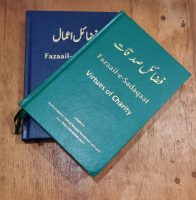
(Fazaa’il-e-A’maal [Urdu] pg. 49-50)