 Ihyaaud Deen An Effort to Revive Deen in Totality
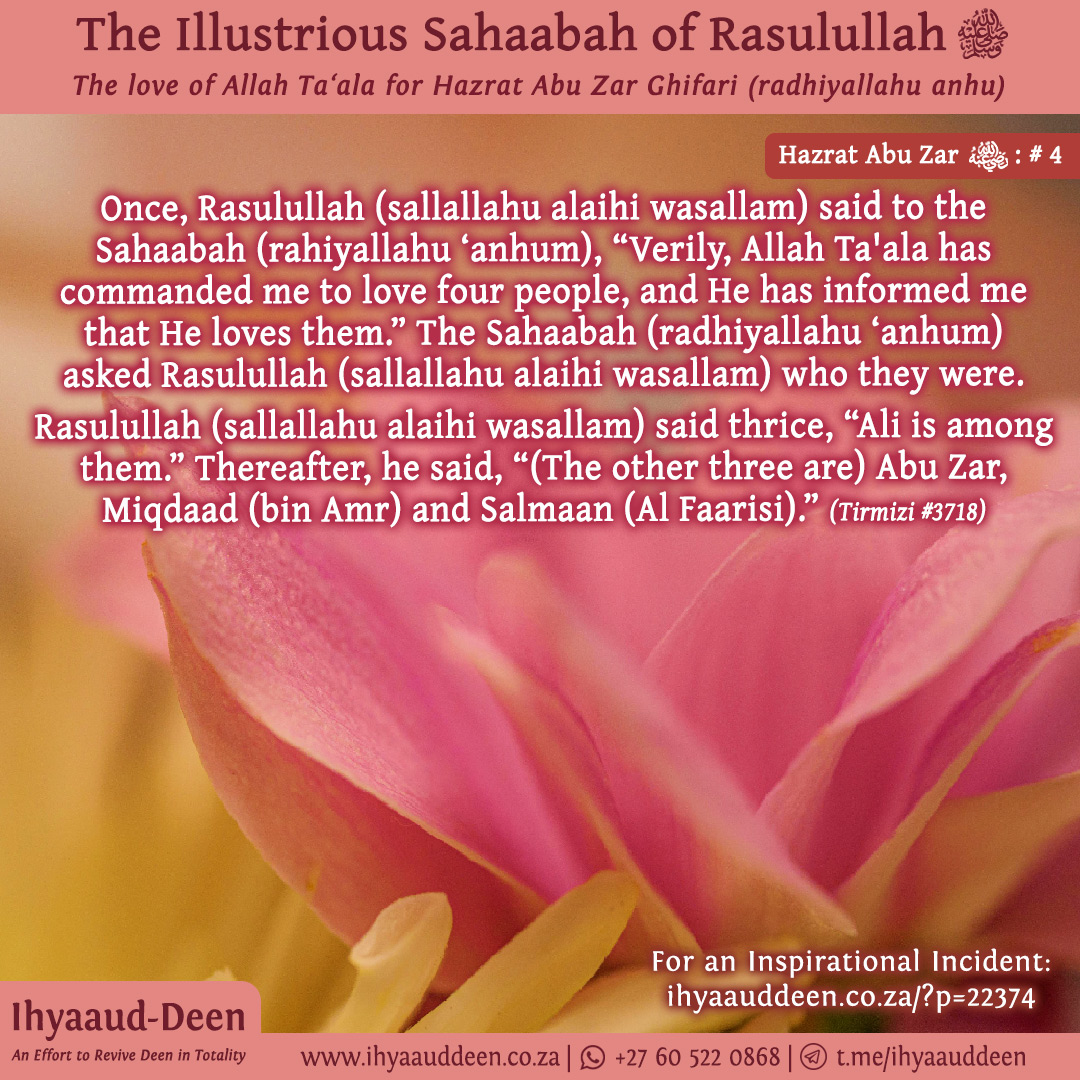
Ma’roor bin Suwaid (rahimahullah) narrates the following:
We once passed by Hazrat Abu Zar (radhiyallahu ‘anhu) in Rabzah and noticed that he was wearing two pieces of mismatched clothing. One was old, while the other was new, and his slave was also wearing two pieces of mismatched clothing, of which one piece was new and the other old.
We therefore said to Hazrat Abu Zar (radhiyallahu ‘anhu), “O Abu Zar (radhiyallahu ‘anhu)! If you wore both pieces of new clothing (by giving your slave the old cloth which you are wearing and taking the new cloth from him), they would have formed a complete set of new clothing that matched each other.”
In reply, Hazrat Abu Zar (radhiyallahu ‘anhu) explained the reason for him dealing with his slave in this manner, where he made him equal to himself saying:
Once, an argument broke out between myself and Hazrat Bilaal (radhiyallahu ‘anhu). During the course of the argument, I insulted him regarding his mother. I said to him, “You are the son of a black woman.” Hazrat Bilaal (radhiyallahu ‘anhu) was hurt at this and he complained to Rasulullah (sallallahu ‘alaihi wasallam) of what I had said to him.
When I later met Rasulullah (sallallahu ‘alaihi wasallam), he said to me, “O Abu Zar (radhiyallahu ‘anhu)! You are a man who still has the traits of Jaahiliyyah (pride) in him.” I was surprised and said to Rasulullah (sallallahu ‘alaihi wasallam), “Is it true that I still have the traits of Jaahiliyyah (pride) in me”?
Rasulullah (sallallahu ‘alaihi wasallam) said, “Yes, you still have the traits of Jaahilyyah (pride) in you (that you think yourself to be better than Bilaal).”
When Hazrat Abu Zar (radhiyallahu ‘anhu) heard this from Rasulullah (sallallahu ‘alaihi wasaalam), he was so affected that he lay on the ground and said, “I will not wake up until Bilaal places his foot on my cheek as an atonement for what I said to him.” It was only after Hazrat Bilaal (radhiyallahu anhu) placed his foot on the cheek of Hazrat Abu Zar (radhiyallahu anhu) that he was satisfied and then woke up.
Rasulullah (sallallahu ‘alaihi wasaalam) then advised Hazrat Abu Zar (radhiyallahu anhu) in a loving manner as to how he should deal with slaves. Rasulullah (sallallahu ‘alaihi wasallam) said, “They are your brothers and slaves whom Allah Ta‘ala has placed in your control. Therefore, you should feed them from the food you eat, clothe them from the clothing you wear, and do not burden them with that which they will not manage. If you burden them with a difficult task then ensure that you assist them (to fulfil it).”
It was on account of this advice of Rasulullah (sallallahu alaihi wasallam) which Hazrat Abu Zar (radhiyallahu ‘anhu) took to heart that throughout his life, he dealt with his slaves in this manner.
(Saheeh Muslim #1661, Saheeh Bukhaari #30, Fat-hul Baari 1/106, Sharhu Ibni Battaal 1/87, Ibn Sa’d 4/179)